
انتخاب عضو هیات علمی دانشگاه اصفهان به عنوان سرآمد علمی جوان
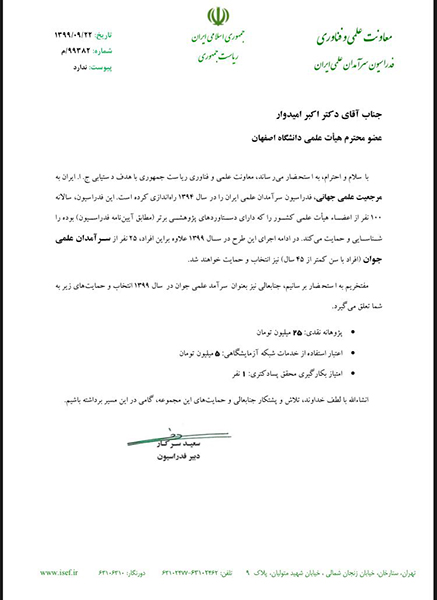
دکتر اکبر امیدوار عضو هیات علمی دانشکده شیمی دانشگاه اصفهان از سوی معاونت علمی و فناوری ریاست جمهوری به عنوان سرآمد علمی جوان سال 1399 معرفی شد.
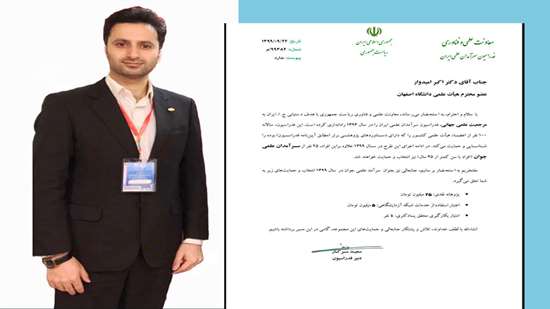
دکتر اکبر امیدوار عضو هیات
علمی دانشکده شیمی دانشگاه اصفهان از سوی معاونت علمی و فناوری ریاست جمهوری به
عنوان سرآمد علمی جوان سال 1399
معرفی شد.
به گزارش
وب سایت خبریuinews معاونت علمی و فناوری ریاست جمهوری با هدف دستیابی ج.ا. ایران به
مرجعیت علمی جهانی، فدراسیون سرآمدان علمی ایران را در سال 1394 راه اندازی کرده است. این
فدراسیون سالانه اعضای هیات علمی کشور را که دارای دستاوردهای پژوهشی برتر( مطابق
آیین نامه فدراسیون) بوده را شناسایی و حمایت میکنند. دکتر اکبر امیدوار، استادیار
دانشکده شیمی دانشگاه اصفهان با کسب اعتبار علمی لازم در فهرست سرآمدان علمی جوان
سال 1399 قرار
گرفته است. دکتر امیدوار فارغ التحصیل مقطع دکتری در رشتهی شیمی (گرایش شیمی
فیزیک) از دانشگاه شیراز می باشد.
زمینههای تحقیقاتی مورد علاقه:
o
شیمی نظری
و محاسباتی
o
مدل
سازی محاسباتی مواد قابل کاربرد در: ابزارهای فتوولتائیک نظیر پیل های خورشیدی و
ترانزیستورهای اثر میدان، باتری ها، مواد نوری غیر خطی، و سوپراتم ها
افتخارات:
o
دانش
آموخته برتر در مقطع دکتری و برنده جایزه شهید تهرانی مقدم-بنیاد ملی نخبگان-1398
o
کسب
حمایت مالی برای دورهی پسادکتری، صندوق حمایت از پژوهشگران و فناوران کشور-1397
مقالات منتشر شده:
Google
Scholar
https://scholar.google.com/citations?hl=en&user=StaU0PsAAAAJ&view_op=list_works&sortby=pubdate
Scopus
https://www.scopus.com/authid/detail.uri?authorId=55026670700
ORCID
https://orcid.org/0000-0003-4691-4564
Publons
https://publons.com/researcher/2973816/akbar-omidvar/
Mendeley
https://www.mendeley.com/impact/akbar-omidvar/
ResearchGate
https://www.researchgate.net/profile/Akbar_Omidvar
(2020)
----------------------------------------------------------------------------------------------------
28. Removal of Toxic Heavy Metal Ions from
Waste Water Using Superchalcogens: A Theoretical Study.
Journal of Environmental Chemical Engineering.
DOI: 10.1016/j.jece.2020.104787
27. Defective Carbon Nanocone as an Anode
Material for Lithium-Ion Batteries.
ACS Applied Energy Materials. DOI: 10.1021/acsaem.0c02457
26. Fine-tuning of charge transport properties
of porphyrin donors for organic solar cell.
Journal of Molecular Liquids. DOI: 10.1016/j.molliq.2020.113403
25. Aqueous solutions of carbohydrates are new
choices of green solvents for highly efficient exfoliation of two-dimensional
nanomaterials.
Journal of Molecular Liquids. DOI: 10.1016/j.molliq.2020.113087
(2019)
----------------------------------------------------------------------------------------------------
24. Fine Structural Tuning of Thieno[3,2‑b] Pyrrole Donor for Designing
Banana-Shaped Semiconductors Relevant to Organic Field Effect Transistors.
Journal of Chemical Information and Modeling.
DOI: 10.1021/acs.jcim.8b00738
23. Design of a Novel Series of Donor-Acceptor
Frameworks via Superalkali-Superhalogen Assemblage to Improve the Nonlinear
Optical Responses.
Inorganic Chemistry. DOI: 10.1021/acs.inorgchem.8b01322
(2018)
----------------------------------------------------------------------------------------------------
22. Fe/Nx clusters embedded in
graphene with tunable properties for gas separation.
Synthetic Metals. DOI: 10.1016/j.synthmet.2018.04.003
(2017)
----------------------------------------------------------------------------------------------------
21. Catalytic role of transition metals
supported on niobium oxide in O2 activation.
Applied Surface Science. DOI: 10.1016/j.apsusc.2017.11.239
20. Indium-doped and positively charged ZnO
nanoclusters: versatile materials for CO detection.
Vacuum. DOI: 10.1016/j.vacuum.2017.10.023
19. Electronic structure tuning and band gap
opening of nitrogen and boron doped holey graphene flake: The role of
single/dual doping.
Materials Chemistry and Physics. DOI: 10.1016/j.matchemphys.2017.09.025
18. Dissociation of O2 molecule on
Fe/Nx clusters embedded in C60 fullerene, carbon nanotube
and graphene.
Synthetic Metals. DOI: 10.1016/j.synthmet.2017.10.010
17. Catalytic activation of O2
molecule by transition metal atoms deposited on the outer surface of BN
nanocluster.
Journal of Molecular Graphics and Modelling.
DOI: 10.1016/j.jmgm.2017.09.001
16. Charge-Controlled Switchable CO Adsorption
on FeN4 Cluster Embedded in Graphene.
Surface Science. DOI: 10.1016/j.susc.2017.10.032
15. Reversible hydrogen adsorption on Co/N4
cluster embedded in graphene: The role of charge manipulation.
Chemical Physics. DOI: 10.1016/j.chemphys.2017.06.010
14.Borophene: A novel boron sheet with a
hexagonal vacancy offering high sensitivity for hydrogen cyanide detection.
Computational and Theoretical Chemistry. DOI: 10.1016/j.comptc.2017.06.018
13. Decoration of doped C60
fullerene with alkali metals: Prototype nanomaterial with enhanced binding
energy toward hydrogen.
International Journal of Hydrogen Energy. DOI:
10.1016/j.ijhydene.2017.03.207
(2016)
----------------------------------------------------------------------------------------------------
12. Carbon nanodots as fluorescent platforms for recognition of fluoride ion
via the inner filter effect of simple arylboronic acids. Experimental and
theoretical investigations.
Journal of Fluorine Chemistry. DOI: 10.1016/j.jfluchem.2016.08.007
11. Reply to the' Comment on “Fullerene-based
materials for solar cell applications: design of novel acceptors for efficient
polymer solar cells-a DFT study”.
Physical Chemistry Chemical Physics. DOI: 10.1039/C5CP07546G
10. Fullerene-based materials for solar cell
applications: design of novel acceptors for efficient polymer solar cells-a DFT
study.
Physical Chemistry Chemical Physics. DOI: 10.1039/C5CP02453F
(2015)
----------------------------------------------------------------------------------------------------
9. Decorated graphyne and its boron nitride
analogue as versatile nanomaterials for CO detection.
Molecular Physics. DOI: 10.1080/00268976.2015.1080388
8. Size Evolution Study of the Electronic and
Magnetic Properties of MgO Nanoclusters.
Physical Chemistry Research. DOI: 10.22036/PCR.2015.7790
7. Promotional effect of the electron donating
functional groups on the gas sensing properties of graphene nanofakes.
RSC Advances. DOI: 10.1039/C5RA10298G
6. A nano tetraimine Pd (0) complex: synthesis,
characterization, computational studies and catalytic applications in the
Heck–Mizoroki reaction in water.
Green Chemistry. DOI: 10.1039/C5GC00616C
(2014)
----------------------------------------------------------------------------------------------------
5. Edge-functionalized graphene nanoflakes as
selective gas sensors.
Sensor and Actuators B: Chemical. DOI: 10.1016/j.snb.2014.05.136
4. Density functional theory study on the
static dipole polarizability of boron nitride nanotubes: single wall and
coaxial systems.
Journal of Physical Chemistry C. DOI: 10.1021/jp410932a
(2013)
----------------------------------------------------------------------------------------------------
3. Density functional theory studies of carbon
nanotube-graphene nanoribbon hybrids.
Journal
Iranian Chemical Society. DOI: 10.1007/s13738-013-0262-0
2. Computational studies on carbon
nanotube-graphene nanoribbon hybrids by density functional theory calculations.
Scientia Iranica. DOI: 10.1016/j.scient.2013.05.018
(2012)
----------------------------------------------------------------------------------------------------
1. Can aluminum nitride nanotubes detect the
toxic NH3 molecules?
Physica
E. DOI: 10.1016/j.physe.2012.02.018
شرکت در کنفرانس ها و سمینارها:
کنفرانس
های بین المللی:
1. Asian
Nano Forum Conference (ANFC), Kish Island, Iran (2015).
2. 3rd
International Conference on UltraFine Grained and Nanostructtred Materials
(UFGNSM), University of Patras & University of Tehran, Tehran, Iran (2011).
کنفرانس های ملی:
1. 19th
Iranian Chemistry Congress, Shiraz University, Shiraz, Iran (2016).
2. 17th
Physical Chemistry Conference, K. N. Toosi University of Technology, Tehran,
Iran (2014).
3. 15th
Physical Chemistry Conference, University of Tehran, Tehran, Iran (2012).
4. 15th
Iranian Chemistry Congress, Bu-Ali Sina University, Hamedan, Iran (2011).
5. 11th
Nanotechnology Conference, Amirkabir University of Technology, Tehran, Iran
(2011).
اطلاعات تماس
دانشکده
شیمی، دانشگاه اصفهان، اصفهان
E-mail:
a.omidvar@sci.ui.ac.ir
Phone:
+98-3137934924
Fax:
+98-3136689732
P.
O. Box: 817467344