

حضور پروفسور زاهد حسن برنده جایزه مصطفی(ص) در دانشگاه اصفهان
پروفسور زاهد حسن استاد فیزیک دانشگاه پرینستون متولد سال 1971 از کشور بنگلادش است، در سال 2021 برنده جایزه مصطفی(ص) شد. این جایزه به خاطر فعالیتهای اثربخش در حوزه مواد کوانتومی توپولوژیک به وی اعطا شده است.
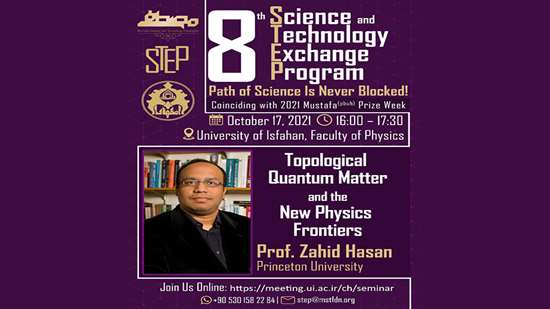
پروفسور زاهد حسن استاد فیزیک دانشگاه پرینستون متولد سال 1971
از کشور بنگلادش است، در سال 2021
برنده جایزه مصطفی(ص) شد. این جایزه به
خاطر فعالیتهای اثربخش در حوزه مواد کوانتومی توپولوژیک به وی اعطا شده است.
به گزارش وب سایت خبری uinews با توجه به سفر دو روزه پرفسور
زاهد حسن از دانشگاه پرینستون آمریکا به دانشگاه اصفهان یک وبینار علمی در روز یکشنبه
25 مهر ماه 1400 ساعت 16 تا 17:30 برگزار
شد.
لازم به ذکر است جایزه مصطفی، یک
جایزهٔ علم و فناوری ایرانی است که هر دو سال یک بار به دانشمندان برتر جهان اسلام
اعطا میشود. این جایزه به نام نبی مکرم اسلام (ص) و به دلیل تأکید بسیار آن حضرت
بر علمآموزی، به نام یکی از القاب آن حضرت یعنی مصطفی، به معنای برگزیده نامگذاری
شدهاست. مبلغ پرداختی به برنده این جایزه 500٬000 دلار آمریکا است که از راههایی
چون وقف داراییهای مؤسسات بزرگ اقتصادی و دانشبنیان، صاحبان سرمایه، یا عموم
علاقهمندان به رشد علمی جوامع اسلامی تأمین میشود.
title/abstract:
"Topological Quantum Matter and the
New Physics Frontiers"
Abstract: Electrons organize in ways to give rise to
distinct phases of matter such as insulators, metals, magnets or superfluid or
superconductors. In the last ten years or so, it has become increasingly clear
that in addition to the symmetry-based classification of matter, topological consideration
of wavefunctions plays a key role in determining distinct or new quantum phases
of matter [see, for an introduction, Hasan & Kane, Reviews of Modern
Physics 82, 3045 (2010)].
In this talk, I briefly introduce these new topological
concepts in the context of their experimental realizations in quantum matter.
As examples, I present how tuning a topological insulator whose surface hosts
an unpaired Dirac fermion can give rise to emergent Weyl fermion and
“fractional” Fermi surfaces; superconductors with helical Cooper pairing
leading to novel Majorana platforms, and strongly correlated magnetic, Chern or
many-body states of matter. These “topological quantum matter” harbor novel and
unprecedented properties that may lead to the development of next generation
quantum technologies.